 Magisk Manager
Quick steps
- Download the Magisk 31.1 APK and install it.
- Unlock your phone's bootloader. On most phones this erases everything, so back up first.
- In the Magisk app, tap Install, then Patch firmware / image, and pick your phone's firmware.
- Flash the patched image with fastboot and restart. Samsung phones use download mode instead.
- Open Magisk. When Installed shows a version number, your phone is rooted.
What is Magisk?
Magisk is a free, open-source tool for rooting Android phones, created by John Wu (topjohnwu) in 2016. It's "systemless": instead of changing files on the system partition, Magisk patches the boot image and applies its changes while the phone starts up. Your system partition stays untouched, which makes Magisk easier to remove and easier to update than older root tools like SuperSU.
What is rooting?
Rooting gives you administrator ("root") access to your phone. Android normally stops you and your apps from changing system files. With root, apps you approve can do things like:
- Block ads system-wide or record internal audio.
- Back up apps together with their data.
- Remove preinstalled apps you can't uninstall otherwise.
- Tune the CPU, battery and display beyond what Settings allows.
What Magisk can do
- Root access (MagiskSU): choose exactly which apps get root, from the Superuser tab.
- Modules: install add-ons that change your phone's system without modifying it, and turn them off with one tap.
- Zygisk and DenyList: run code inside apps, or revert Magisk's changes for the apps you choose.
- MagiskBoot and resetprop: tools for unpacking boot images and changing read-only system properties.
What is the Magisk app?
The Magisk app is the APK you install to set up and manage Magisk. It used to be called Magisk Manager. Since Magisk v22 it's a single file that does everything: it patches your firmware to install Magisk, controls which apps get root, manages modules, and uninstalls Magisk when you're done.
From the app you can:
- See whether Magisk is installed and up to date.
- Grant or revoke root access for each app in the Superuser tab.
- Install, update and turn off modules in the Modules tab.
- Restart into safe mode if a module causes problems.
- Follow module installs and module actions in the built-in terminal.
Magisk v31 introduced a completely redesigned app, so older screenshots and videos online won't match what you see. The steps below use the current names for every button.
Download the latest Magisk version
| App name | Magisk (formerly Magisk Manager) |
|---|---|
| Latest version | 31.1 |
| Last updated | October 25, 2026 |
| File size | 10.2 MB |
| Requires | Android 7.0 or newer |
| Developer | topjohnwu |
| License | Free and open source (GPL-3.0) |
| Source code | github.com/topjohnwu/Magisk |
Only download Magisk from its official GitHub page or a site that links to it, like this one. Modified "Magisk" APKs from other sources are a common way to spread malware. If you want new features early, see Magisk Beta.
Before you start
You'll need:
- An unlocked bootloader. The steps depend on your phone's brand. Unlocking usually wipes the device.
- A computer with ADB and fastboot (Android SDK Platform-Tools) and a USB cable.
- Your phone's official firmware for the exact version installed right now: the full OTA or factory image
.zip, or just the image Magisk needs from it (which one?). On Pixel phones the Magisk app can download it for you. - Android 7.0 or newer and at least 50% battery.
Planning to use a custom kernel too? Install Magisk first and flash the kernel afterwards.
How to install the Magisk app
Download the Magisk APK
Tap the download button above. The file,
Magisk-v31.1.apk, is saved to your Downloads folder.Open the APK
Open the file from your browser or the Files app. Android may warn that your browser isn't allowed to install apps. Tap Settings.
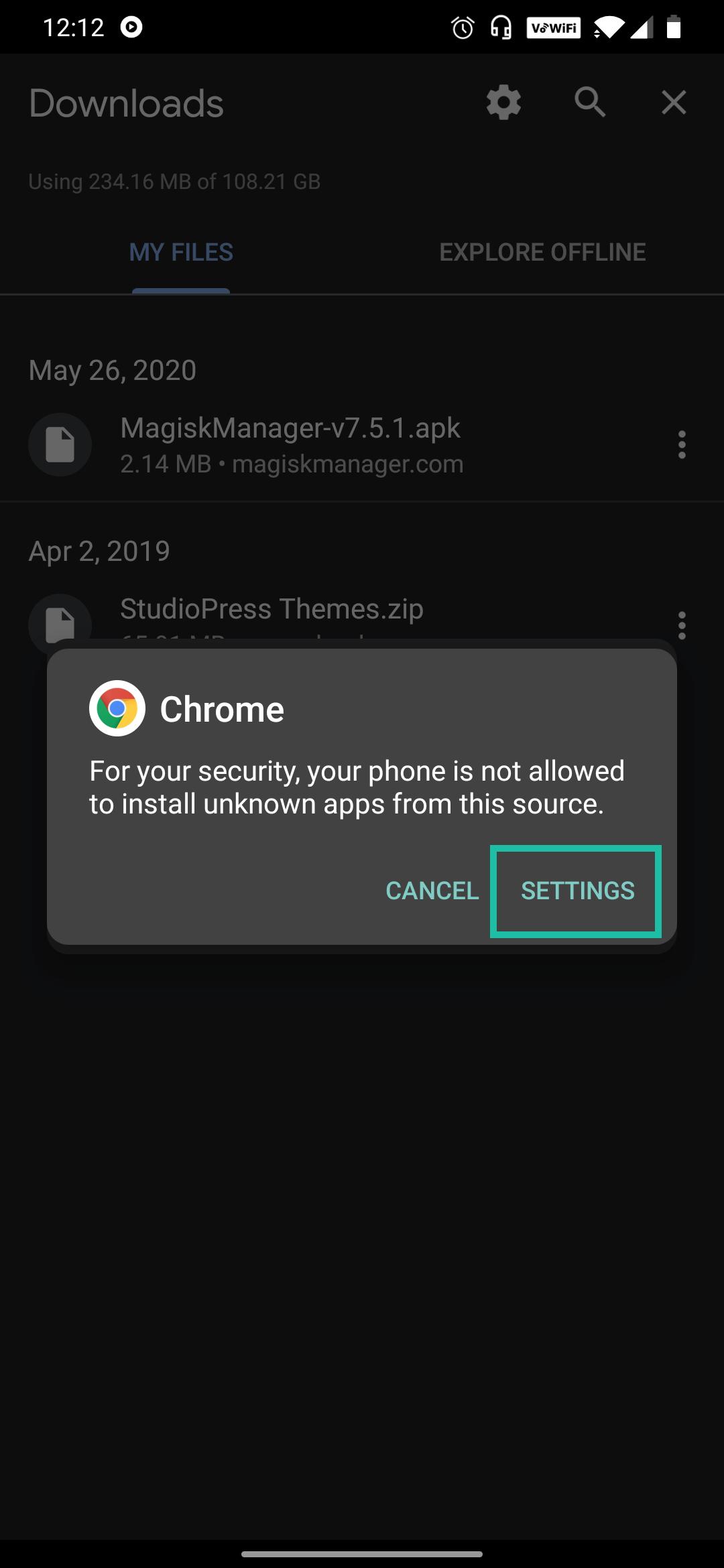
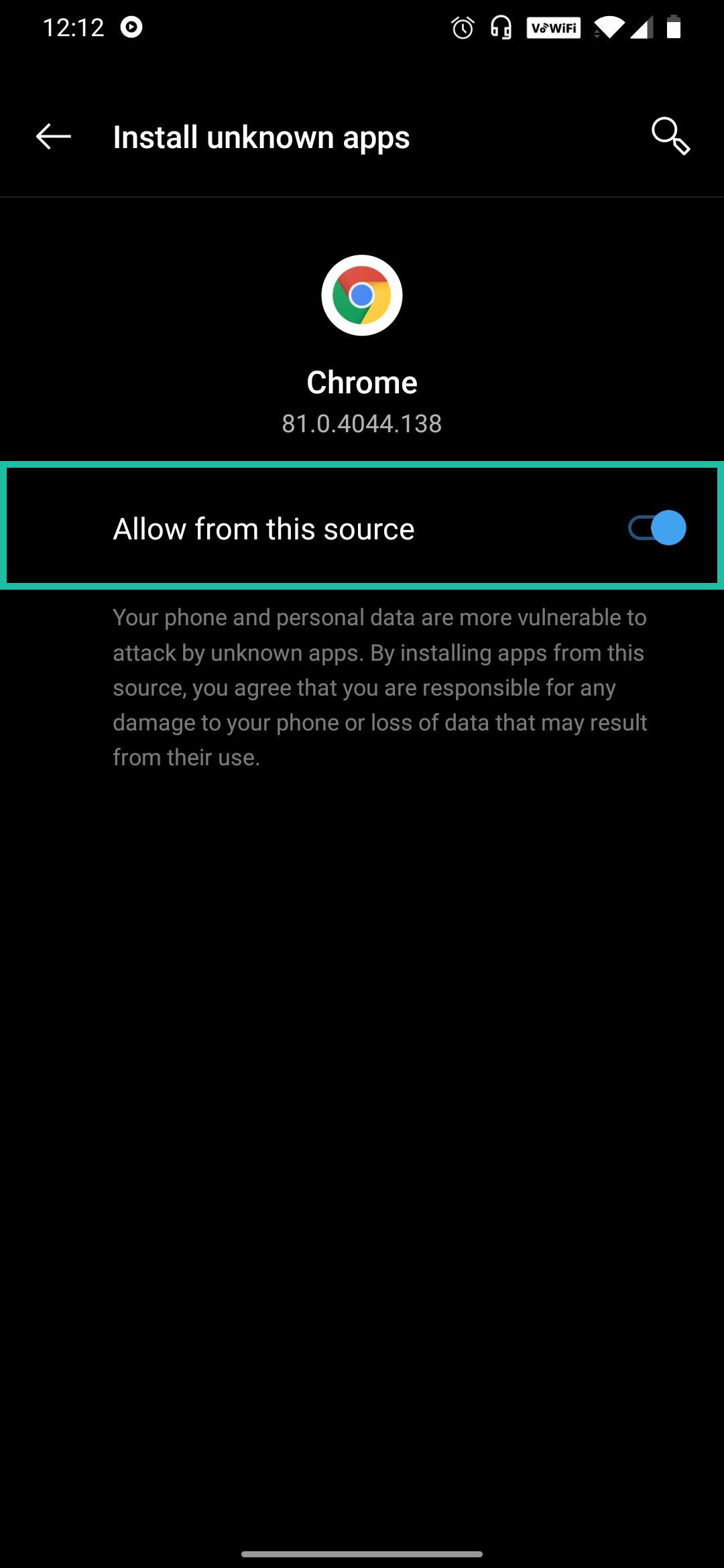
Allow installs from this source
Turn on Allow from this source, then go back.
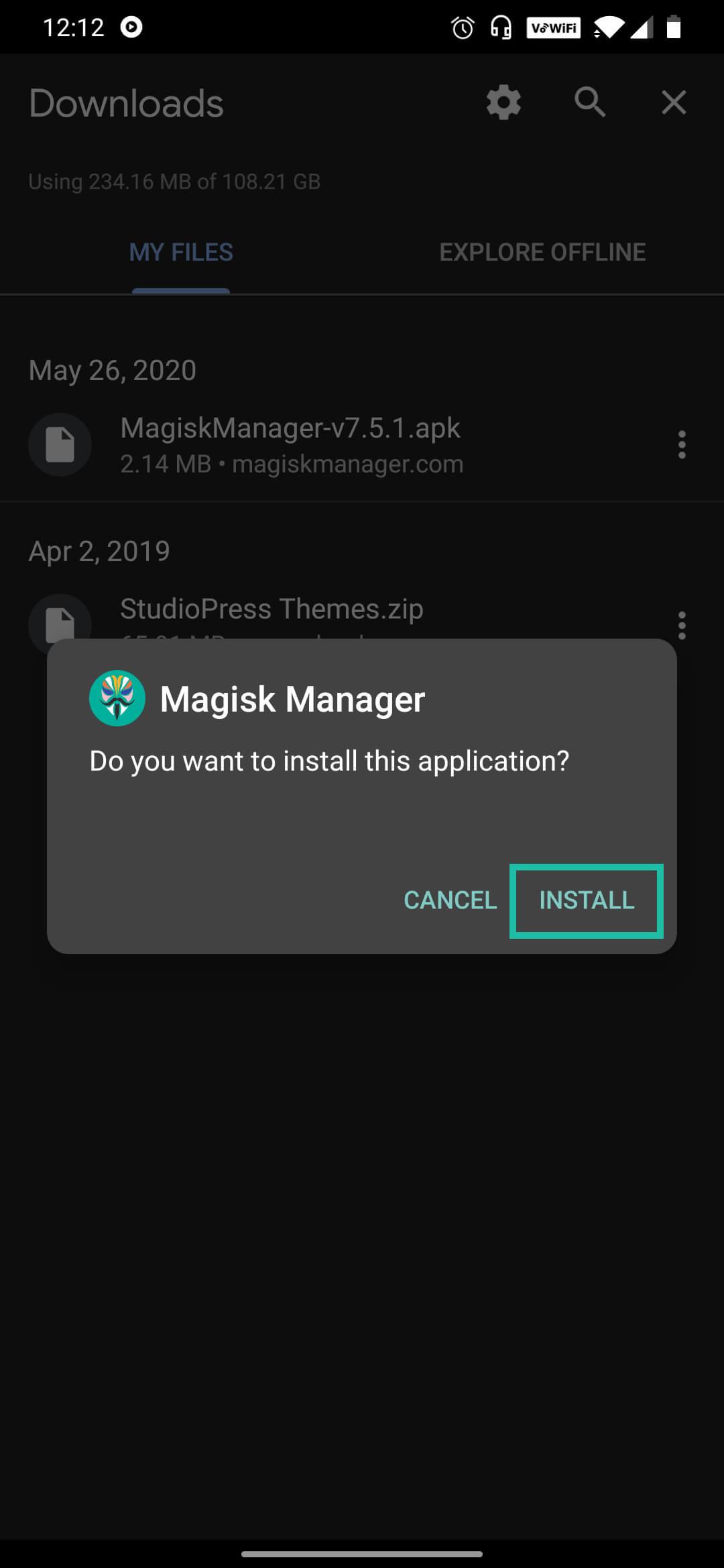
Install the app
Tap Install and wait a few seconds.
Open Magisk and check Ramdisk
On the home screen, find Ramdisk in the Magisk card and note whether it says Yes or No. You'll need it in the next section.
Installing the app alone doesn't root your phone. To root, patch your firmware as shown next.
Which image should you patch?
Magisk installs itself into the ramdisk, the small part of the start-up image that runs first when your phone boots. Phones keep the ramdisk in different places, so the image you patch depends on your phone. Check the Ramdisk line in the Magisk app, then find your phone below:
| Your phone | Image to patch |
|---|---|
| Ramdisk: Yes, launched with Android 13 or later (most recent phones) | init_boot.img |
| Ramdisk: Yes, launched with Android 12 or earlier | boot.img |
Ramdisk: Yes, ramdisk stored in vendor_boot (a few phones) | vendor_boot.img |
| Ramdisk: No | recovery.img (details) |
| Samsung | The whole AP firmware file (Samsung steps) |
You flash the patched file to the partition with the same name: a patched init_boot.img goes to init_boot, a patched boot.img to boot, and so on. Not sure which one you have? Give the Magisk app the complete firmware package (OTA .zip, factory image .zip or payload.bin) and it picks the right image itself.
How to root your phone with Magisk (recommended method)
This is the method Magisk's developer recommends in the official installation guide. The Magisk app patches a copy of your phone's boot image, and you flash that copy with fastboot. Samsung phones work differently: skip to the Samsung steps.
Get your firmware onto the phone
Copy the official firmware for your exact build to your phone: the full OTA or factory image
.zip(orpayload.bin), or just the image you need from it. The Magisk app finds the right image inside a full package by itself. On a Pixel, you can skip this step.Patch it in the Magisk app
In the Magisk card, tap Install. If you're patching
recovery.img(Ramdisk: No), turn on Recovery Mode first. Under Method, choose Patch firmware / image, then pick the source:- Select from storage for the file you copied.
- Enter image URL to use a direct link to an OTA or factory image.
- Download latest Pixel factory image on Pixel phones.
Tap Let's go. The patched file is saved in your Download folder as
magisk_patched-[version]_[random].img.Copy the patched image to your computer
Use ADB rather than drag-and-drop over MTP, which can corrupt large files. Replace the file name with yours:
adb pull /sdcard/Download/magisk_patched-31100_AbCdE.imgReboot into the bootloader
adb reboot bootloaderFlash the patched image
Flash it to the partition the original image came from. On most phones that launched with Android 13 or later that's
init_boot. On older phones it'sboot.fastboot flash init_boot magisk_patched-31100_AbCdE.imgfastboot flash boot magisk_patched-31100_AbCdE.imgIf you patched
vendor_boot.imgorrecovery.img, usevendor_bootorrecoveryin the same command.Optional: turn off vbmeta verification
Some phones won't start a modified image until verified boot checks are turned off. If your phone has a separate
vbmetapartition, you can flash the stockvbmeta.imgfrom your firmware with the checks disabled. This can erase your data, so back up first.fastboot flash vbmeta --disable-verity --disable-verification vbmeta.imgRestart and finish setup
fastboot rebootOpen the Magisk app. If your data was erased, install the Magisk APK again first. When the app asks for additional setup, tap OK and let the phone restart once more. When Installed shows a version number, your phone is rooted.
If the app says Ramdisk: No (Magisk in recovery)
Some phones, mostly A-only models from late 2018 and 2019, have no ramdisk in their boot image. On these phones Magisk can only live in the recovery partition. Patch recovery.img with Recovery Mode turned on, then flash it to recovery as shown above.
After that, the way you turn the phone on decides whether Magisk runs:
- Power on normally: Android starts without Magisk.
- Hold your phone's recovery key combination, then let go of every button as soon as the phone vibrates and the logo appears: Android starts with Magisk.
- Hold the recovery key combination, then keep holding Volume up: the phone opens the real recovery.
The recovery key combination depends on the model (on a Galaxy S10 it's Power + Bixby + Volume up). On these phones you can't install or update Magisk with a custom recovery such as TWRP.
A few phones, mostly certain Xiaomi models, report Ramdisk: No but still start a patched boot image. There's no way to detect this in advance. If you want to try the normal method, keep your stock boot image so you can flash it back if the phone doesn't start.
How to root a Samsung phone with Magisk
Samsung phones don't use fastboot. Instead, you patch the AP file from Samsung's firmware in the Magisk app and flash it in download mode.
Check that your Samsung can be unlocked
In Settings → Device care, turn on Maintenance mode. Then turn the phone off and start it in download mode with your model's key combination. Look for these two lines:
| Download mode shows | What it means |
|---|---|
| OEM Lock: ON (L) | Fully locked. Unlock it with the steps below. |
| OEM Lock: ON (U) | The bootloader is locked, but OEM unlocking is turned on. |
| OEM Lock: OFF (U) | Fully unlocked. |
| No OEM Lock line | This model probably can't be unlocked. This is common on phones sold in the USA and Canada. |
| KnoxGuard: Active or Locked | Your carrier or insurer has locked the phone remotely. Magisk can't be installed or run, even with an unlocked bootloader. |
| KnoxGuard: Prenormal | A temporary lock. It should clear once the phone has been switched on for 168 hours (7 days). |
| KnoxGuard: Checking, Completed or Broken | Not locked. You can continue. |
Unlock the bootloader
Allow unlocking. In Settings → Developer options, turn on OEM unlocking.
Start download mode. Turn the phone off and hold your model's download mode key combination.
Unlock. Press and hold Volume up to unlock the bootloader. The phone erases everything and restarts.
Set the phone up quickly. Skip what you can, because the phone will be erased again later, but connect to the internet during setup.
Check the result. Turn on Developer options again. OEM unlocking should be there and greyed out. That means KnoxGuard hasn't locked the phone, and download mode now accepts modified firmware.
Patch and flash the AP file
Download your firmware. Get the latest official firmware for your exact model, for example with samloader-rs, a tool from Magisk's developer that downloads it straight from Samsung's servers. Unzip it.
Copy the AP file to the phone. Its name looks like
AP_[model]_[version].tar.md5.Patch it. Install the Magisk app and tap Install in the Magisk card. If the app shows Ramdisk: No, turn on Recovery Mode. Choose Patch firmware / image, then Select from storage, and pick the AP file.
Copy the patched file to your computer with ADB. Don't drag it over MTP, which is known to corrupt large files.
adb pull /sdcard/Download/magisk_patched-31100_AbCdE.tarFlash it in download mode. Restart into download mode. Flash the patched file as AP, together with BL, CP and CSC from the original firmware. Use
CSC, notHOME_CSC: the first install needs a full wipe. You can flash with samloader-rs or with an Odin-style flashing tool, which has the same AP, BL, CP and CSC slots.Let the phone reset. It restarts by itself after flashing. If it asks to factory reset, agree. On a Ramdisk: No phone, start it with the recovery key combination this time so Magisk loads.
Finish in the app. Install the Magisk app again and open it. When it asks for additional setup, let it finish. The phone restarts once more, and then it's rooted.
Installing system updates on a rooted Samsung
A rooted Samsung phone can't install system updates over the air. To update, download the new firmware, patch its AP file in the Magisk app the same way, and flash it. This time, use HOME_CSC instead of CSC, because you're updating and want to keep your data.
How to install Magisk on a Googlebook
Googlebooks are Google's Android-based laptops. They don't use fastboot either: the Magisk app writes a patched recovery image to a USB drive, and the Googlebook reinstalls itself from that drive. Your data isn't erased, because Magisk removes the factory reset step from the image while patching it.
Unlock the bootloader by following Google's instructions for Googlebooks.
Patch the recovery image. Install the Magisk app on the Googlebook, tap Install in the Magisk card and choose Patch firmware / image. Pick Download latest Googlebook recovery image, which the app suggests automatically, or choose your own file with Select from storage or Enter image URL.
Choose where to write it. Under Output destination, select a USB flash drive plugged into the Googlebook. Everything on the drive is erased. You can also choose Save to file and write the image to a drive later with Google's Device Recovery Utility for Chrome.
Boot from the drive. Start the Googlebook in recovery mode and pick the USB drive. The Googlebook reinstalls its system from the drive, with Magisk included.
Googlebooks use A/B system updates, so you can install updates and keep root the same way as on a Pixel: see How to update Magisk.
How to install Magisk with TWRP (custom recovery)
Magisk's developer now calls this method deprecated and keeps it working with minimal effort. It only works on phones with Ramdisk: Yes, and it fails on many phones from the last few years. Use it only on older phones where patching isn't possible.
Install TWRP
Flash TWRP for your exact phone model.
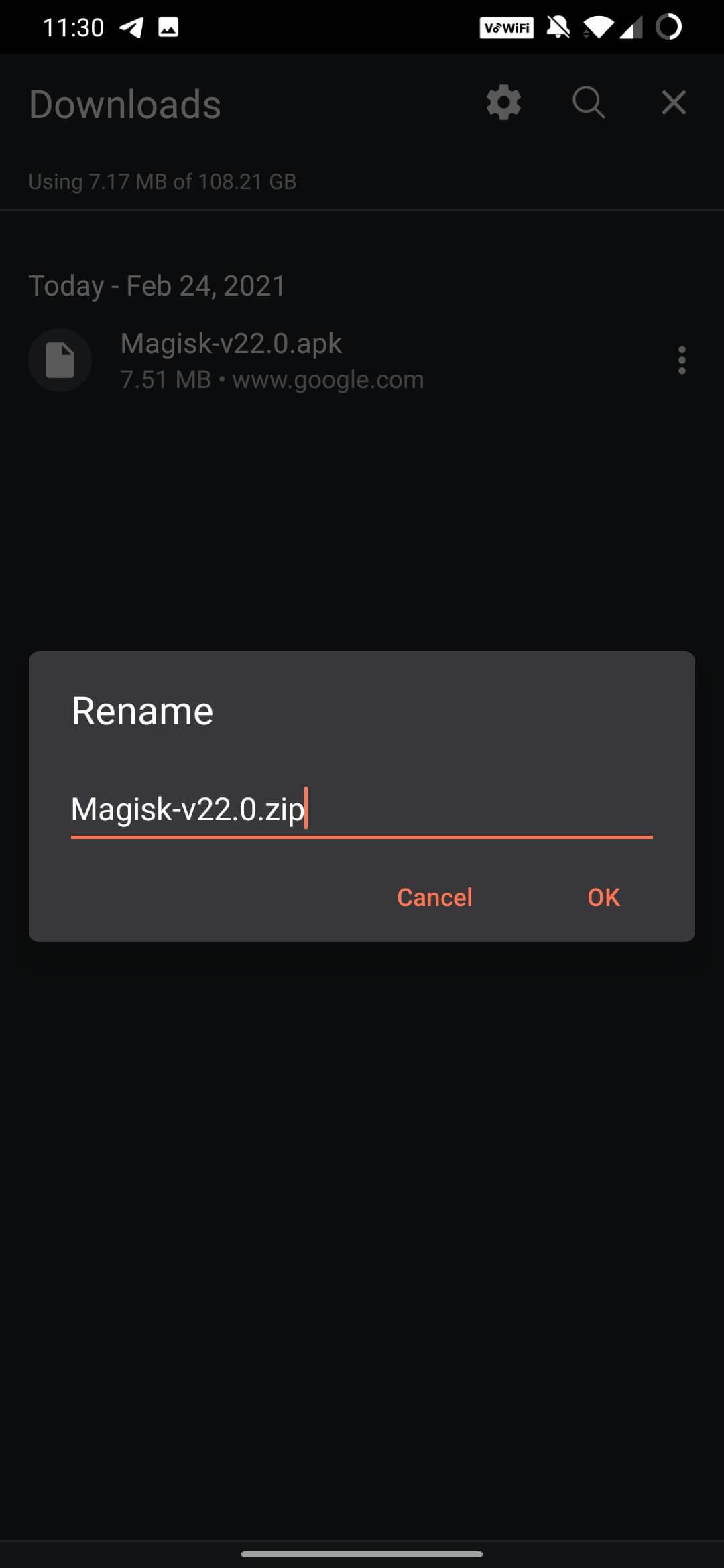
Rename the APK to .zip
In your Files app, rename
Magisk-v31.1.apktoMagisk-v31.1.zip.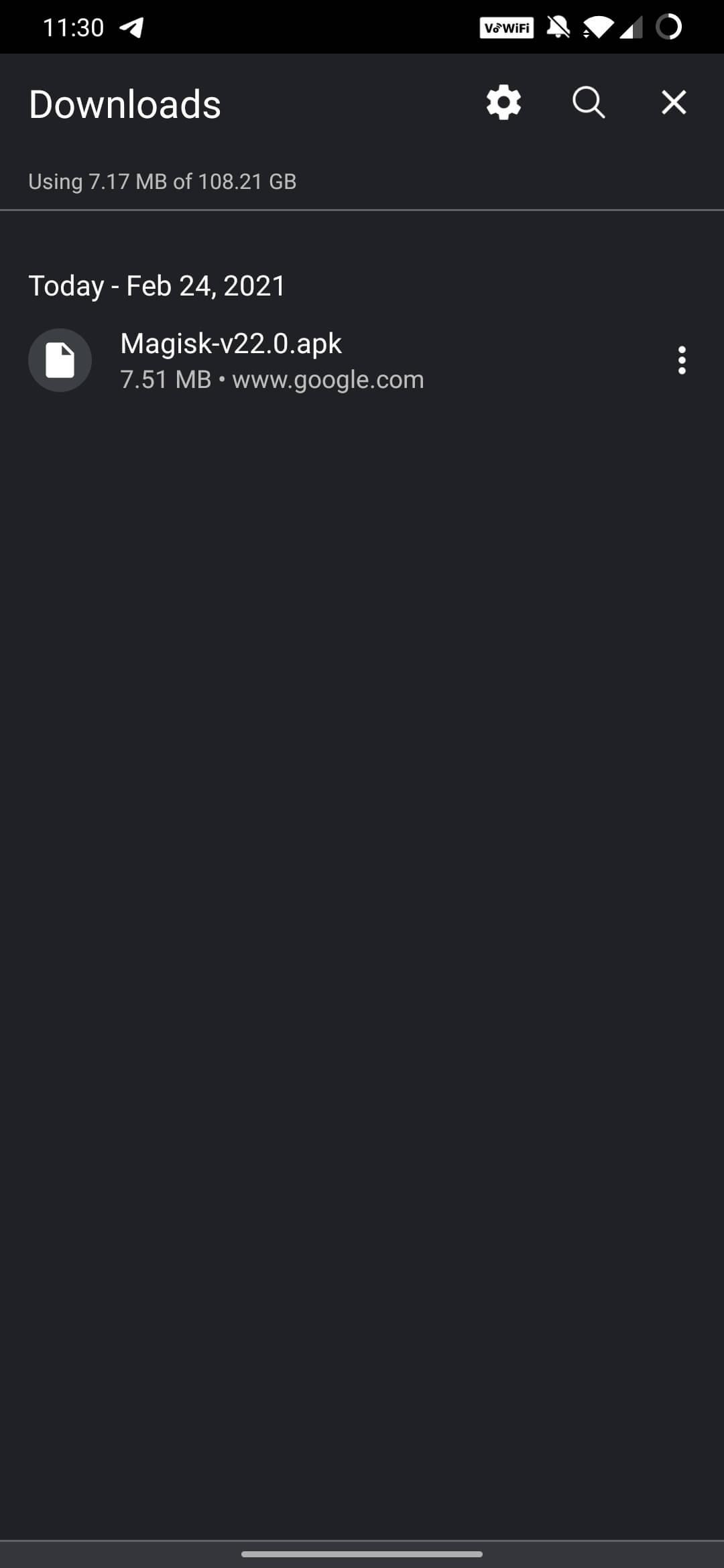
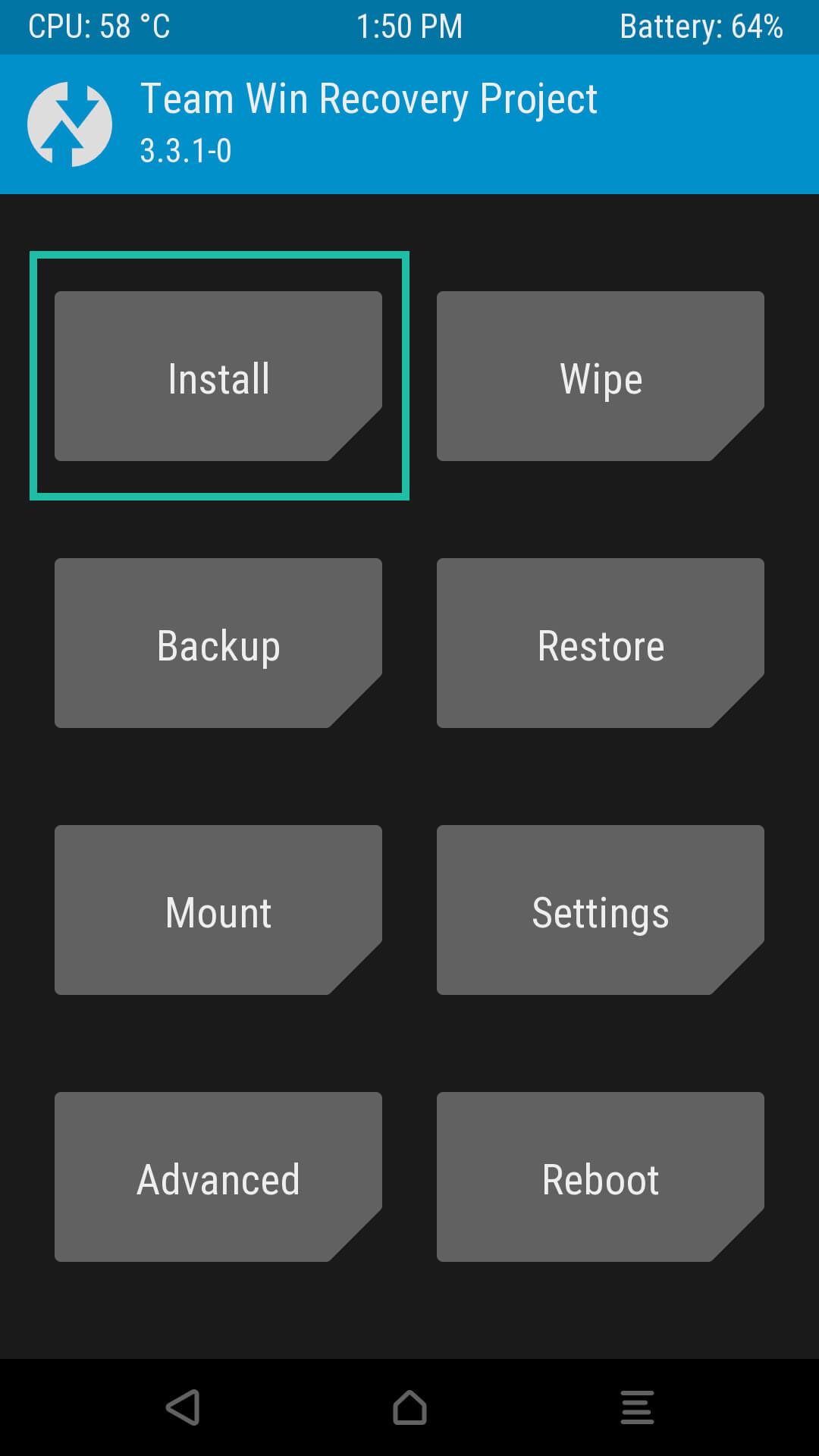
Boot into TWRP
Turn the phone off, then hold Power + Volume down (the combination varies by brand) until TWRP opens. Tap Install.
Select the Magisk zip
Go to your Download folder and tap the Magisk
.zipfile.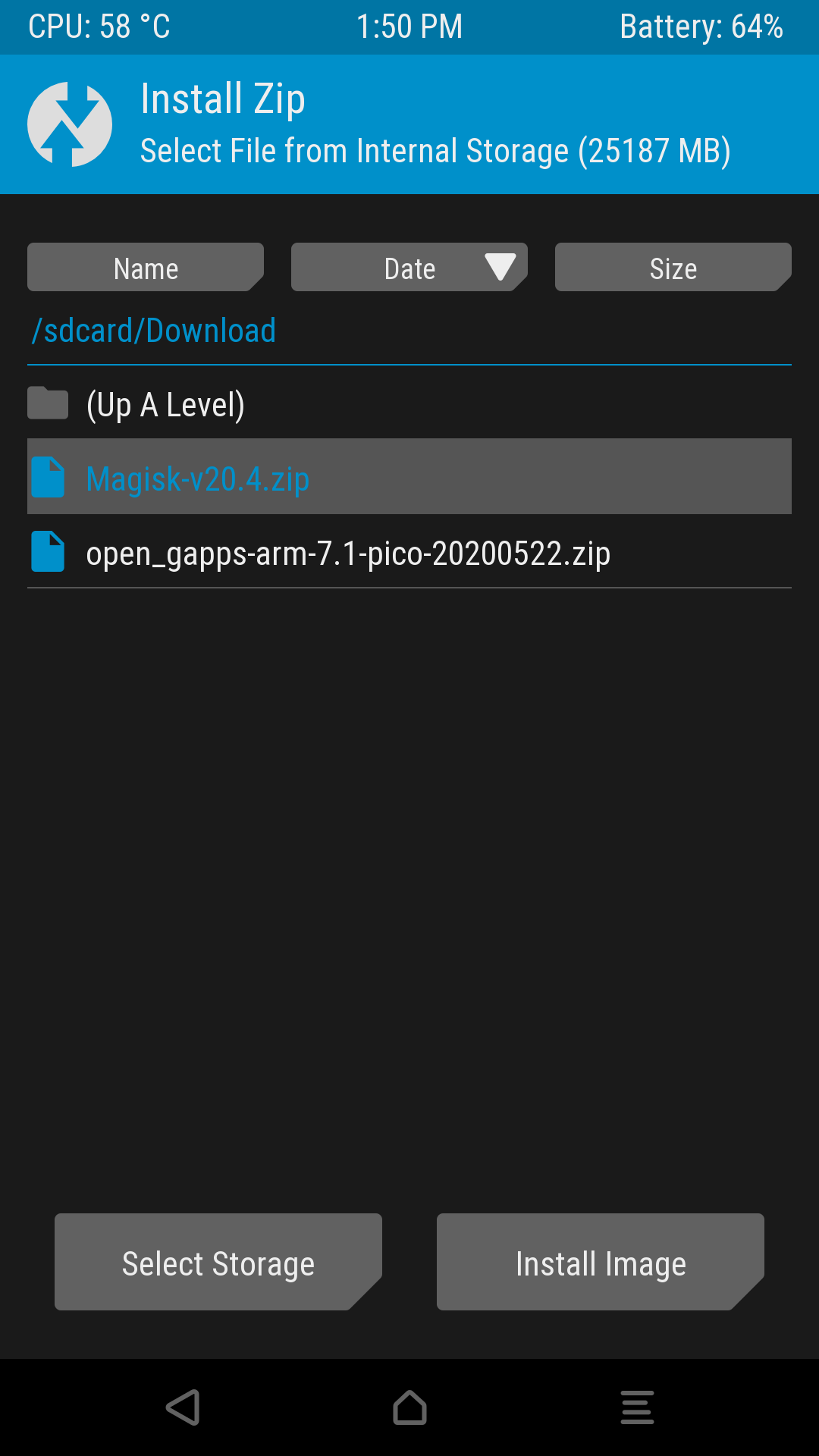
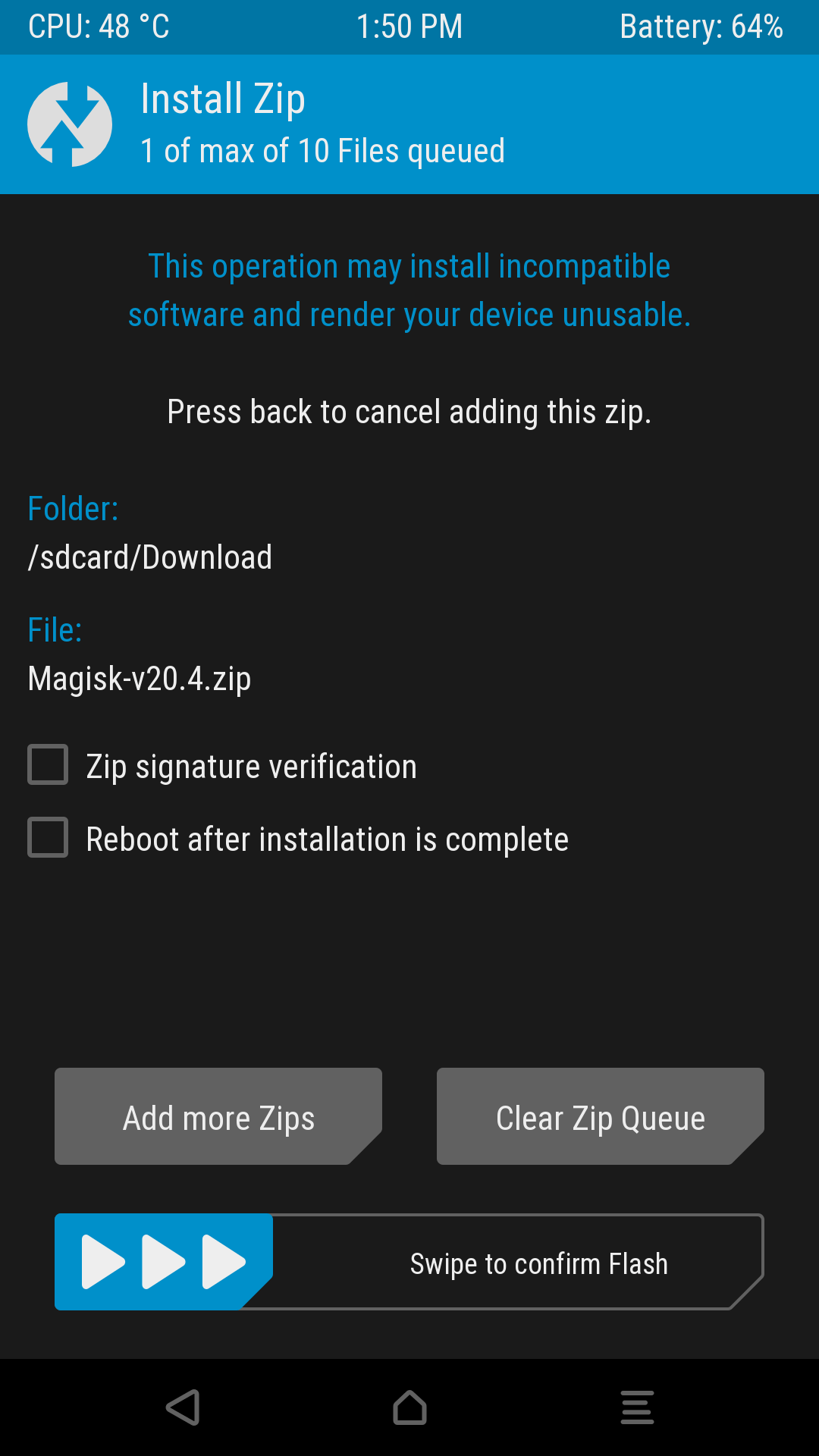
Swipe to flash
Swipe the slider at the bottom to confirm and wait for the install to finish.
Reboot and install the app
Tap Reboot System. When the phone starts, install the Magisk APK if it isn't on your phone yet.
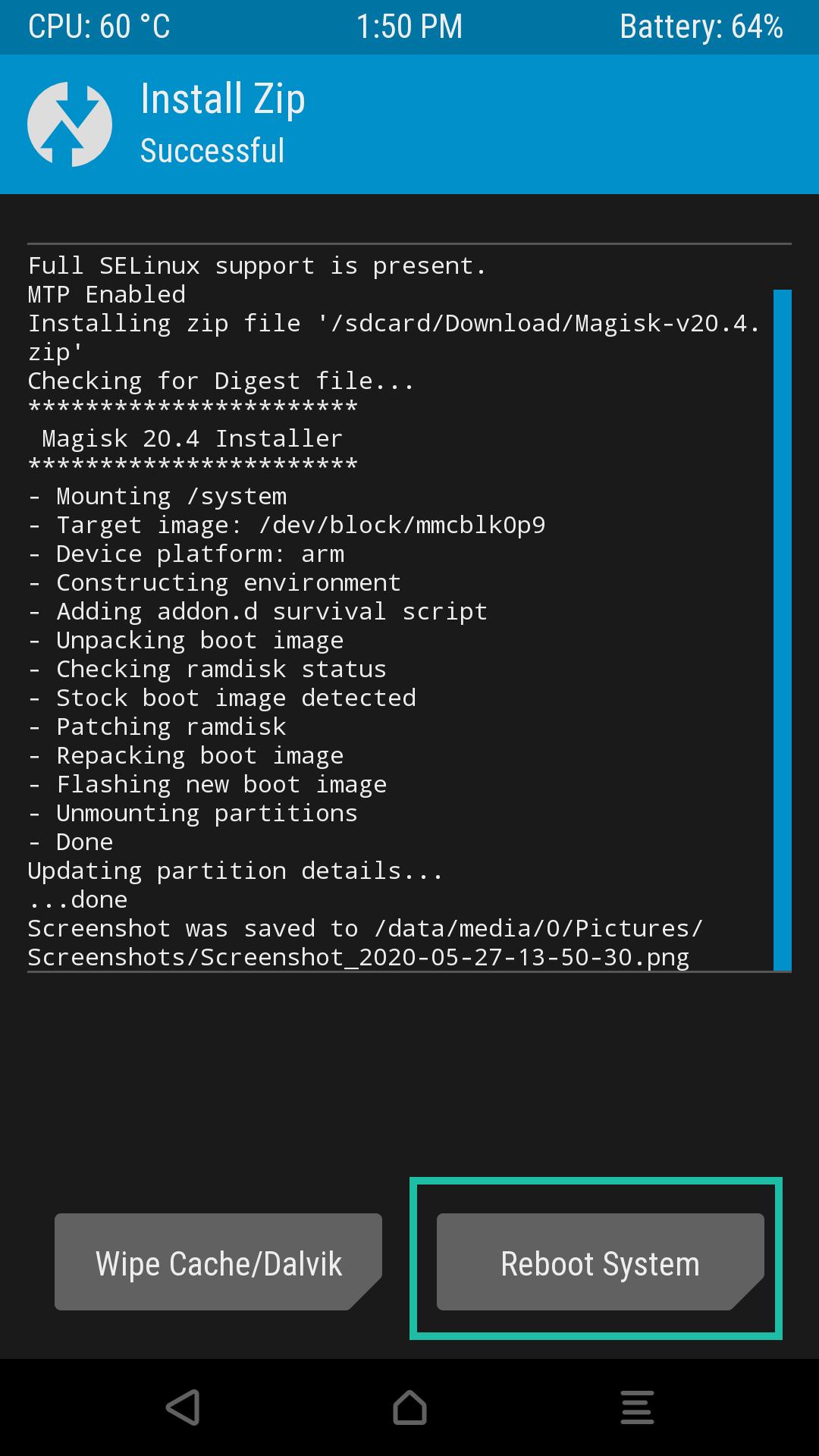
Finish the install in the app
Open the Magisk app. When it offers to reinstall Magisk, do it from inside the app and restart. When Installed shows a version number, you're rooted. On some MediaTek phones the boot partition is locked once Android is running, so this step fails. On those, patch the boot image and flash it with TWRP or fastboot instead.
How to update Magisk
When a new version is out, the Magisk app offers to update itself. Update the app first, then tap Install in the Magisk card and choose Direct install (Recommended). Restart when it's done. This is the recommended way to update; you don't need to patch and flash an image again. Want new features before everyone else? Switch to the beta channel.
Keep root through a system update
A system update (OTA) replaces your patched boot image and removes root. On phones with A/B partitions (seamless updates) you can keep root, as long as you've never modified read-only partitions such as system or vendor yourself. Even mounting one of them as writable makes the update fail its checks.
- Turn off Automatic system updates in Developer options so updates don't install on their own.
- When an update arrives, open Magisk, tap Uninstall Magisk, then Restore images. Don't restart, or Magisk will be gone. Pixel phones and Googlebooks can skip this step: Google sends them a full update when it detects changes.
- Install the system update and wait until it has completely finished, including the optimizing stage. Don't tap Restart now yet.
- In Magisk, tap Install and choose Install to inactive slot (After OTA).
- Go back to the system update screen and tap Restart now.
Magisk's developer only tests this routine on Pixel phones, so other brands may behave differently. On phones without A/B partitions, patch the new firmware and flash it again after updating. Samsung phones need a different routine.
How to uninstall Magisk
The easiest way is from the app: open Magisk, tap Uninstall Magisk, then Complete uninstall. Magisk restores your original boot image, removes all modules and restarts the phone.
If your phone doesn't start or the app won't open, you can flash Magisk as uninstall.zip from TWRP or flash your stock boot image with fastboot. Don't flash stock boot images on a Samsung phone, though: see why. Our full uninstall guide covers every method.
How to hide root from apps (DenyList, formerly Magisk Hide)
Older guides tell you to turn on Magisk Hide. That option was removed in Magisk v24. Today the DenyList is the closest replacement: for each app on the list, Magisk reverts its changes so the app sees an unmodified system.
Turn on Zygisk
Open the Magisk app, go to Settings, turn on Zygisk, and restart your phone.
Enforce the DenyList
Back in Settings, turn on Enforce DenyList.
Choose apps
Tap Configure DenyList and select the apps that refuse to run on rooted phones, for example your banking app. Tap an app to expand it and make sure all of its processes are selected.
Clear the app's data
Clear the storage of the app you're hiding root from, then open it again.
Some apps look for the Magisk app itself. Magisk v31.1 removed the option to hide the app under a random name. Instead, once you've granted root and set up your modules, you can uninstall the Magisk app from Android Settings. Root and modules keep working, and you can reinstall the app whenever you need to change something.
Common problems and fixes
An app says it doesn't have root. Since Magisk v31.1 there's no pop-up when an app asks for root. Open the Magisk app, go to the Superuser tab and grant access to that app.
The Magisk app crashes or freezes. Clear the app's storage in Android Settings, or uninstall it and install the latest APK again.
"There was a problem while parsing the package." The download is incomplete or your Android version is too old. Download the APK again, and check that your phone runs Android 7.0 or newer.
Installed shows "N/A". Magisk isn't in your boot image yet. Patch the firmware again and make sure you flashed it to the right partition. On a Ramdisk: No phone, Magisk only runs when you start the phone with the recovery key combination.
The phone won't start after flashing the patched image. Flash the stock image from the same firmware back to the same partition to get your phone working again (not on Samsung phones). Check that the firmware matches the exact build on your phone, and that you picked the right image. If your phone has a vbmeta partition, it may need verification turned off.
The phone is stuck on the boot logo after installing a module. Magisk protects you automatically: if the phone fails to start twice in a row, the next start uses Magisk's safe mode, with every module and Zygisk turned off. You can also turn on safe mode yourself:
- If the phone still starts: in the Magisk app, tap the power icon at the top of the home screen, choose safe mode and restart.
- With the volume button: press and hold Volume down a few seconds before the boot animation appears and let go as soon as it does. Many guides say to press it when the logo shows, which is too late for Magisk. If you keep holding until Android has started, Android's own safe mode turns on as well.
- Over USB: if USB debugging is on, connect the phone to a computer and run the command below. It removes every module and restarts the phone.
adb wait-for-device shell magisk --remove-modules
Our uninstall guide covers more ways to recover a phone that won't start.
Root doesn't work in a work profile or second user. By default only the device owner gets root. Change this under Multiuser mode in the Magisk app's settings.
Frequently asked questions
Is Magisk Manager safe to use?
The app itself is safe when you download it from the official source. Magisk is open source, its code is public on GitHub, and every download button on this site points to topjohnwu's official GitHub release. Rooting does carry risk: a wrong image can leave your phone unable to boot, and root access lets the apps you approve change anything on the device. Back up first and only give root to apps you trust.
Is Magisk free?
Yes. Magisk is free and open source under the GPL-3.0 license. You never have to pay to download it, root your phone or install modules.
Is rooting Android legal?
In most countries it is legal to root a phone you own. It can void your warranty, and some manufacturers refuse repairs on rooted or unlocked devices. Laws differ from country to country, so check yours if you're unsure.
Why is my phone not supported by Magisk?
Magisk works on almost any Android phone whose bootloader can be unlocked. If your phone isn't supported, the bootloader is usually locked for good: many carrier-sold phones, and Samsung phones sold in the USA and Canada, can't be unlocked. The other common cause is patching firmware that doesn't match the exact build installed on your phone.
Can I root a Samsung phone with Magisk?
Yes, if its bootloader can be unlocked and KnoxGuard hasn't locked it. Samsung phones sold in the USA and Canada usually can't be unlocked. Rooting permanently trips Knox, which turns off Samsung Wallet, Secure Folder and other Knox features, and the first install erases the phone. Follow how to root a Samsung phone.
Which Android versions does Magisk support?
The current Magisk release supports Android 7.0 and newer, including the latest Android version. Magisk v31.1 dropped support for Android 6.0. Older phones need an older Magisk release, which we don't recommend.
Why doesn't Magisk ask me to grant root anymore?
Magisk v31.1 removed the pop-up that used to appear when an app asked for root. Open the app that needs root once, then open the Magisk app, go to the Superuser tab and grant it access there.
Why does my phone keep losing root?
Root disappears when the patched boot image is replaced, almost always by a system update. Patch the new firmware again after updating, or on phones with A/B partitions use Install to inactive slot (After OTA) as described in How to update Magisk.
Why is Magisk not working properly on my phone?
Open the Magisk app and check Installed on the home screen. If it says N/A, Magisk isn't in your boot image yet: patch and flash it again, and make sure you flashed the right partition (boot or init_boot). Also check that you patched firmware from the exact version on your phone, never an image from another device. See common problems and fixes.
What happened to Magisk Hide?
Magisk Hide was removed in Magisk v24. The closest replacement is the DenyList, which reverts Magisk's changes for the apps you pick. Magisk's developer no longer treats hiding root as a Magisk feature. See how to hide root from apps.
Does Magisk pass SafetyNet or Play Integrity?
Google has retired SafetyNet and replaced it with the Play Integrity API. Magisk on its own doesn't make a rooted phone pass Play Integrity, and with an unlocked bootloader most phones fail the strongest checks. Some banking and payment apps will therefore refuse to run on a rooted phone.
Is Magisk Manager the same as the Magisk app?
Yes. The companion app used to be called Magisk Manager and was a separate download from Magisk itself. Since Magisk v22 there is a single APK, simply called the Magisk app, that installs, updates and removes Magisk.
Can I use a custom kernel with Magisk?
Yes. Install Magisk first and flash the custom kernel afterwards, which is the order Magisk's official guide recommends. If the Magisk app shows N/A under Installed after you flash the kernel, patch and flash your boot image again.
Can I use Magisk on an Android emulator?
Yes, on the official Android emulator that comes with Android Studio. Magisk's source code includes a script that loads Magisk into a running emulator, or patches the emulator's ramdisk so Magisk stays after a restart. Other emulators may work if SELinux is turned on. The commands are in the official Magisk FAQ.
Share this guide
More Magisk guides
- 4 min readDownload Magisk Beta 31.1 Latest Version For Android 2026Get the newest Magisk beta from the official GitHub pre-releases, switch the Magisk app to the beta channel, and go back to stable if something breaks.Read the guide
- 4 min readHow to Uninstall Magisk From Android [2 Easiest Methods]Remove Magisk and root from your Android phone: uninstall from the Magisk app in one tap, use TWRP if the app won't open, or flash the stock boot image.Read the guide